Carved in Batangas
Not all of Batangas' best spots are on the map. Two stops, one road south, and a whole lot of volcanic stone.
TRAVEL
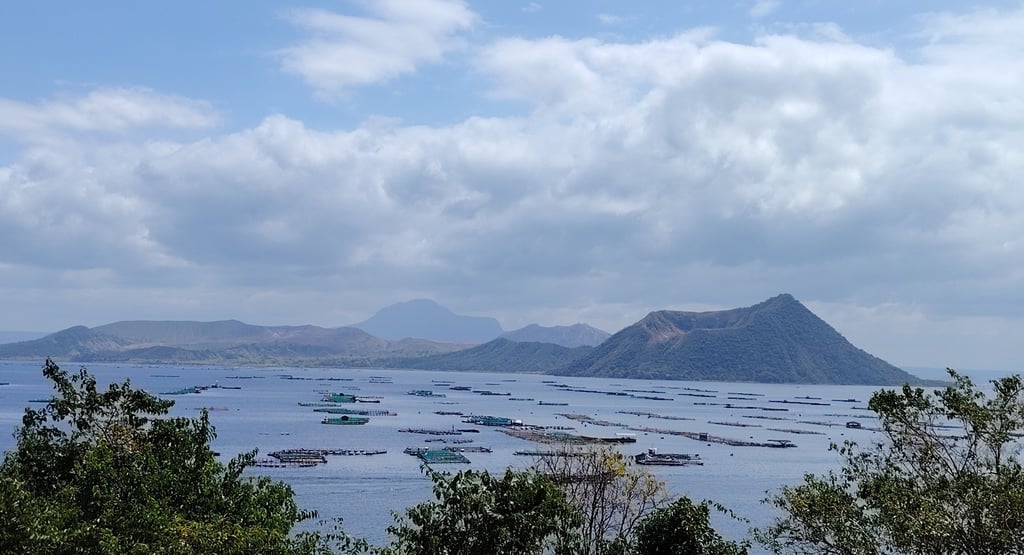
If you’ve only ever driven through Batangas on the way to a beach resort or a coffee stop in Tagaytay, it’s time to slow down and look a little closer. Pressed up against the volcanic ridgeline of Tagaytay to the north and spilling down to the glass-still waters of Taal Lake, this province south of Manila is one of those rare places where the landscape itself becomes the story. It is a province of old churches and colonial-era towns, of bancas drifting across a caldera, of mornings that smell of fresh barako coffee and fish just off the boat. But the real surprises lie off the main road. Beyond the well-worn routes of the heritage trail, quieter discoveries await those willing to take an unplanned turn off the highway — a rock formation that became a chapel, a lakeshore castle that became a playground. Both are built, in their own way, from stone. Both, in their own way, endure. Here’s why both deserve a spot on your itinerary.
Stop One: A Rock Chapel That Will Quietly Take Your Breath Away
Laurel, Batangas
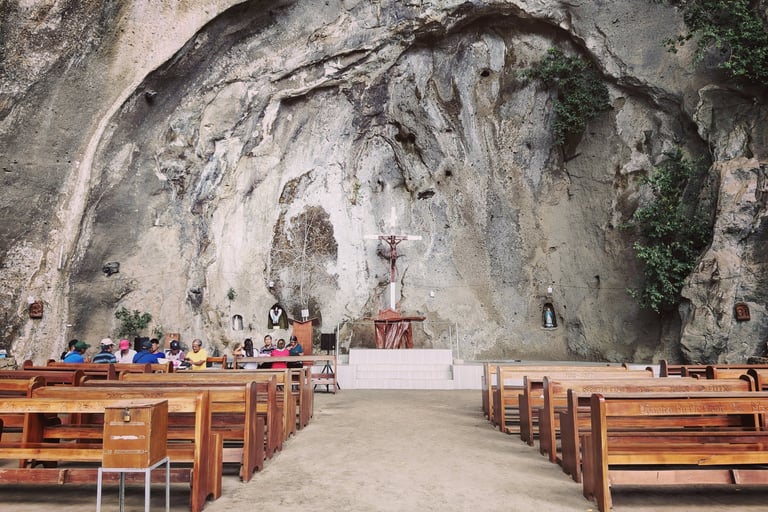
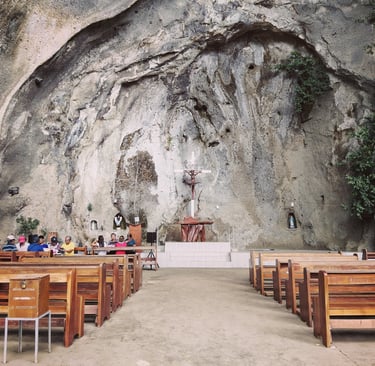
Lent has a particular quality in the Philippine countryside — quieter than the city, more insistent. It arrives not just on the calendar but in the atmosphere, in the slow tempo of towns that seem to draw inward, turning toward older rhythms. It was with this spirit of searching that the road south beckoned, winding along the rim of Taal Lake, through small municipalities that are smaller than their roadside signage might suggest, punctuated by the occasional yellow arches and the glow of convenience store signs — reminders that modernity has found even these shores. The destination: Laurel, Batangas — a municipality that rarely appears on travel shortlists, and is all the better for it.
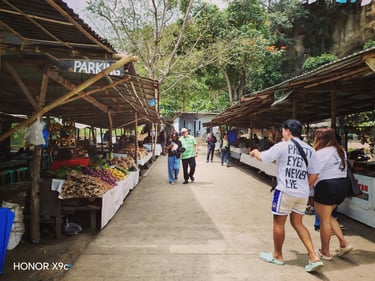
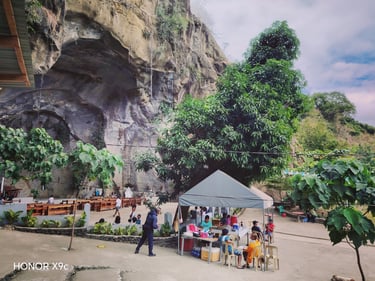
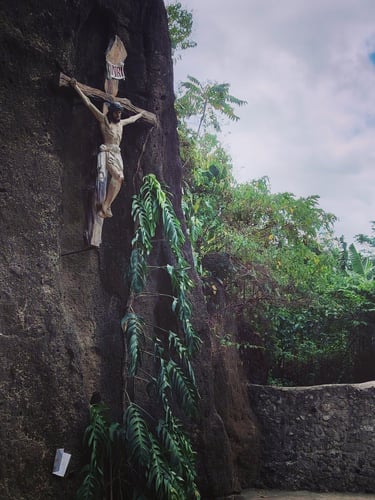
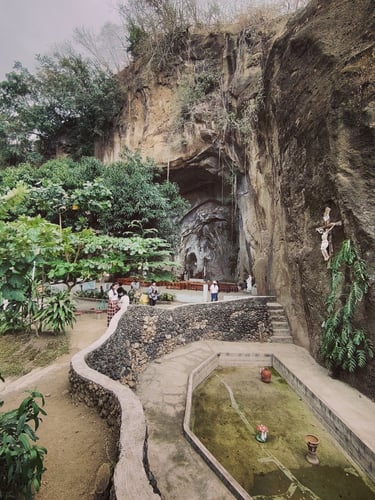
The chapel announces itself through absence. There are no grand gates, no billboards, no manicured approach. From the highway, an unmarked turn leads to a road that gradually sheds its pavement, softening to dirt before opening into a quiet community where seemingly every flat stretch of ground has been converted to parking — a telling sign that on certain days, this place fills far beyond what its appearance would suggest.
Then, at an elevation above the surrounding barangay, shaded by the broad canopy of old mango trees, it reveals itself: a natural rock formation so improbably shaped that it seems less discovered than bestowed. This is not a structure built by hands — it is a space that nature carved and a community consecrated. The volcanic stone is riddled with hollows where moss persists and small creatures have made their homes, and the whole arrangement opens outward like a natural amphitheater, as if the earth itself had designed a place for gathering.
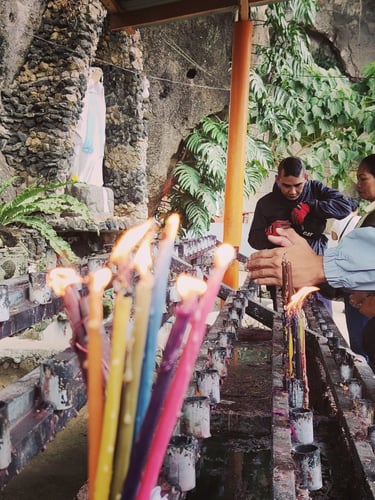
Long before any official consecration, the community already knew this place as sacred ground. They called it simba-simbahan — a makeshift church — or tuklong, a temporary sanctuary, names that acknowledged its informality while honoring its function. To stand there during Lent is to understand exactly why it held that role. On the morning of this visit, the air was filled with the drone of pabasa, the oral recitation of the Passion of Christ, delivered in deep, unornamented Tagalog — none of the familiar sing-song cadence, but something older and more grave. Without a local to explain, a visitor might not have placed it at all.
Tucked into one of the rock's hollowed alcoves is a figure of Our Lady of Lourdes, a fitting presence in a setting so naturally grotto-like. The association feels earned rather than imposed: a place where the divine already seemed to reside, and where a particular devotion found its home.
The sanctuary is not without its vulnerabilities. Locals speak with measured worry about a large development corporation that has been acquiring land in the area — land that, despite the presence of a place of worship, has not been entirely exempt from commercial interest. Recent storms have also taken their toll; one is said to have altered the course of a nearby spring. The hope, voiced quietly by those who tend the place, is that proper authorities will intervene before overcommercialization strips it of the very quality that draws people here.
For now, the community has organized itself gently around the sanctuary’s small economy: modest stalls offering local produce, pasalubong, and candles line the approach. The vendors are unhurried and undemanding — there is no pressure, no hawking — and that restraint is itself a kind of grace. The reason people come here is spiritual, and the place, to its credit, still knows that. Pick up a candle, browse the stalls, and let the pace of the place slow you down.
"Keep it for the locals," a visitor might whisper, and mean it as the highest form of praise.
Whether or not it’s Holy Week when you visit, this rock church is worth making a destination in its own right — a journey southward to a place where faith and stone have been keeping each other company for generations. Add it to your Batangas route, and leave plenty of time to simply sit with it.
With thanks to the locals of Laurel.
Stop Two: A Lakeside Castle That’s Exactly as Fun as It Looks
Tanauan, Batangas
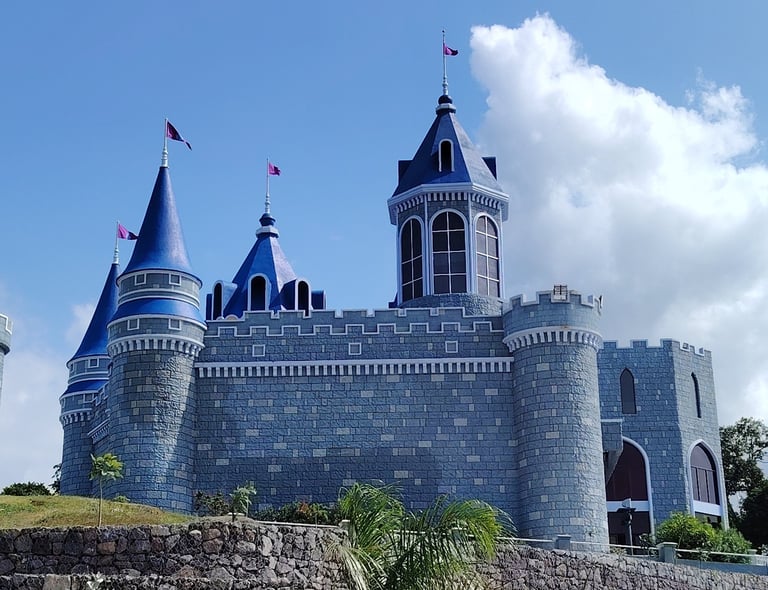
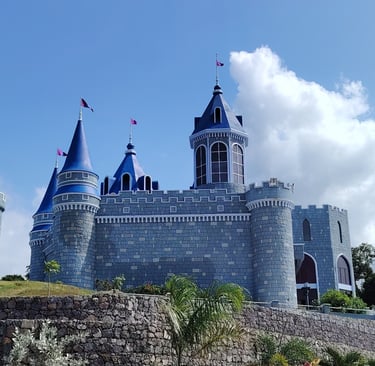
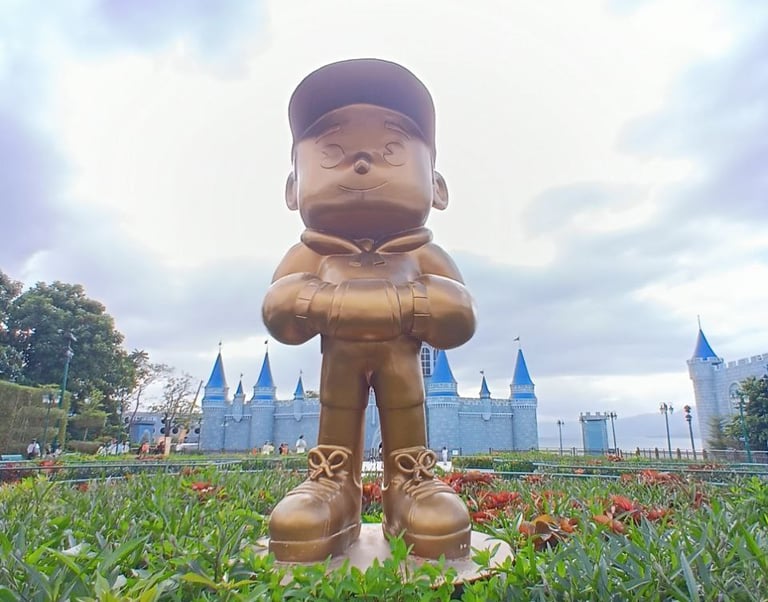
A newly paved road hugging the shores of Taal Lake in Tanauan suddenly offered up something unexpected in the middle distance: towers. Battlements. What appeared to be gazebos rising against the ridge. It had the quality of a mirage, this apparition of a lakeside castle, and the only sensible response was to follow the road toward it.
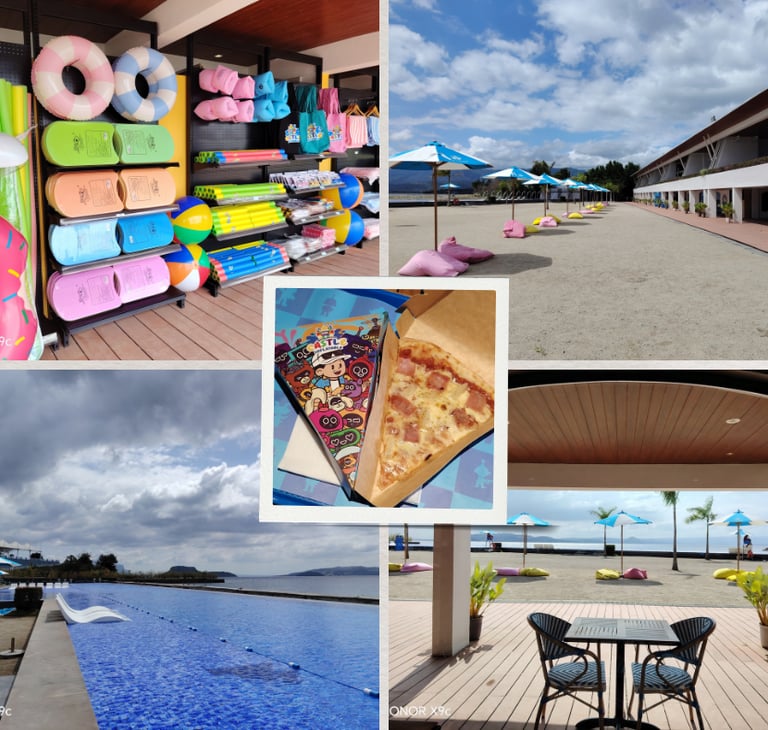
Up close, J Castles resolves itself into something thoroughly, delightfully real: a theme park with genuine architectural ambition, anchored by stone castle structures and arrayed across a property that uses its elevation and its lake frontage to spectacular effect. The park is divided into two complementary experiences — J Castles proper and Castle Inflatables — and each earns its place on the itinerary. Budget a full day; you’ll want it.
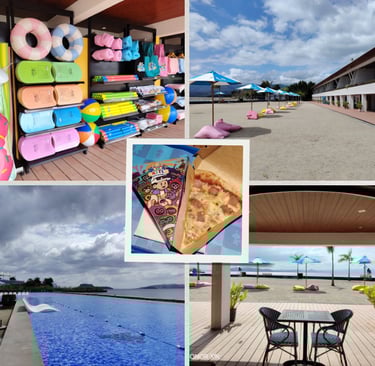
Castle Inflatables claims the lakeshore — and honestly, it might be where you end up spending most of your afternoon. After a long drive, the idea of time by the water is immediately appealing, and the property delivers on it generously. A sandy expanse holds large inflatable obstacle courses designed for groups and families — the kind of equipment that, even when deserted, communicates the particular joy of people bouncing through them. But the real centerpiece is the infinity pool stretching along the property’s edge: roughly a hundred meters of still water framing an unbroken view of Taal Lake. Beach umbrellas and lounge chairs line the perimeter, calibrated for those who have earned the right to do absolutely nothing for a while. The Boat House, the park’s waterside eatery, offers meals and snacks at prices that do not feel like a penalty for having chosen to spend a day here.
What is immediately striking about Castle Inflatables is the standard of upkeep — worth flagging for any traveler who has been burned by promises of a “resort experience” that looked better in photos. For a facility barely a year in operation, it is immaculate — a signal that maintenance is a philosophy here, not an afterthought. More notable still: the lifeguard presence. At least three or four were observed on duty during the visit, attentive at their posts regardless of how many — or how few — swimmers were in the water. In an industry where safety is often the first economy made, that ratio says something meaningful.
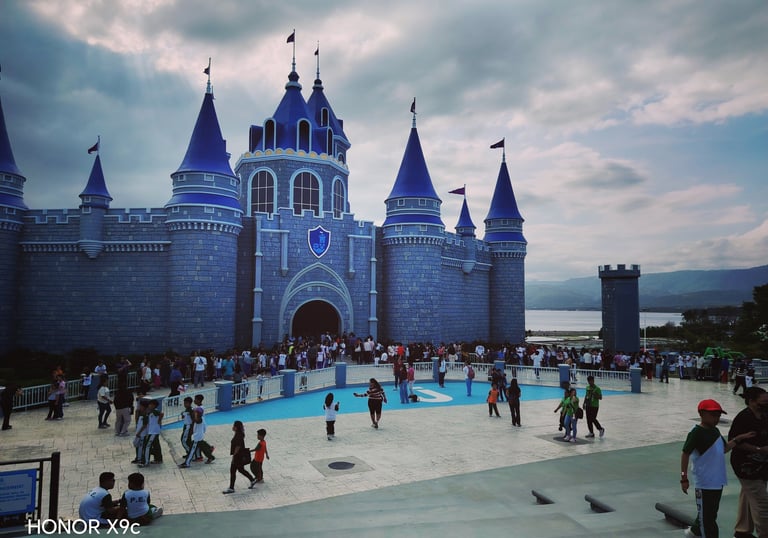
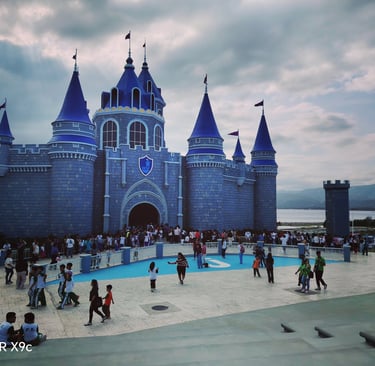
J Castles, the park's elevated centerpiece, has a different register entirely. The approach up to the main grounds is its own reward, the stone castle structures appearing first as silhouettes against the skyline before resolving into fully realized facades, towers, and courtyards. The photography opportunities alone could sustain an afternoon: angles that frame the castle against the lake's silver surface, or catch the green spine of the Tagaytay ridge in the background. But the park is more than a backdrop. Rides and game booths add kinetic energy to the grounds, and the construction activity visible beyond the perimeter walls promised more: the outlines of a coaster rail, a giant wheel, and what appeared to be a very tall drop tower. A dedicated kiddie zone and an interactive talk show stage round out a property that is, in its current form, already larger than it first appears.
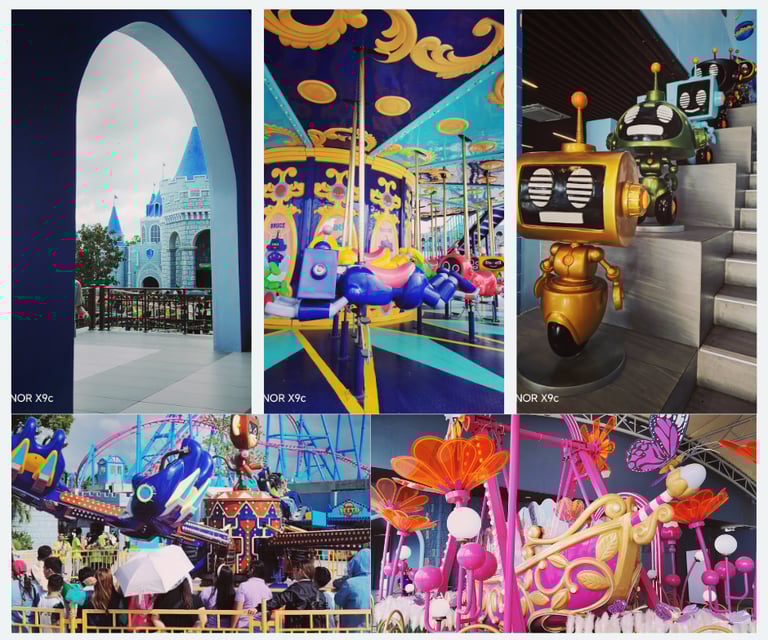
Before you leave, stop at Blue Burger. The name is not metaphorical. The burger is, in fact, blue — and whatever one makes of that choice, it is the kind of thing that rewards the curious. Consider it your souvenir.
J Castles is popular for school field trips and corporate outings, and the park seems designed with volume in mind — which makes the spaciousness of the grounds all the more impressive.


For those searching for a full day’s escape from the city — one that offers both the languor of a lakeside afternoon and the particular happiness of a place built to delight — J Castles makes a compelling case for itself. Walk-ins are welcome, though checking ahead is advisable, especially on weekends when the park draws school field trips and corporate outings in significant volume. On those busy days, the park still somehow manages not to feel crowded or hurried. There is room to wander, to pause, to find a bench with a view and simply be in it.
With thanks to May, Potch, and Joy of J Castles.