The most dangerous opponent wears no uniform
Alex Eala's Wimbledon run isn't just history — it's a lesson in resilience. After beating Iga Świątek, Alex faces Jasmine Paolini in the Round of 16. This op-ed explores the real opponent every champion fights after a big win: the voice inside that says "you've done enough."
OP-ED
Bryan Gerard Cabrera
7/6/20265 min read
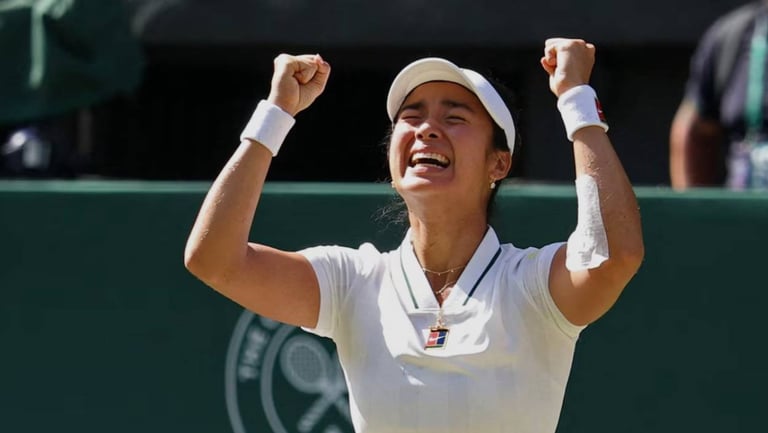
History has already been made. When Alex Eala stepped onto the grass courts of Wimbledon to face defending champion Iga Świątek, millions of Filipinos hoped for a miracle.
What they got was something bigger. They watched a young Filipina compete without fear, beat one of the best players in the world, and become the first Filipino to reach the fourth round of a Grand Slam singles tournament.
For most people, that victory was the whole story. For me, the more interesting story started the next day.
As Alex prepares to face Jasmine Paolini in the Round of 16, analysts are already breaking down every angle: tactics, serving patterns, footwork, how she might get past her next opponent. That's their job.
But listening to those conversations, I kept thinking about an opponent no scouting report can capture. One no camera can film. One every athlete eventually meets — and it wears no uniform.
What if the greatest opponent isn't the one standing across the net?
One photo, one story
As an athlete, I have learned that the greatest challenge doesn't always come before the biggest victory. More often than not, it comes immediately after it.
The world celebrates your achievement. Headlines are written. Social media erupts with praise. Friends, family, and even strangers begin calling you an inspiration. Yet while everyone else is looking backward at what you've accomplished, you must somehow find the courage to keep looking forward. That is one of the loneliest moments in competition. It is also one of the most defining.
Like any elite athlete coming off an emotionally and physically demanding victory, Alex now faces the inevitable demands of recovery. Every sprint across the baseline. Every explosive change of direction. Every aching muscle. Every full-stretch dive to keep a rally alive leaves its mark.
Elite athletes understand that victory has a physical cost. The body remembers every point. Recovery, therefore, becomes as important as preparation. But physical fatigue is rarely the hardest opponent.
The hardest match starts after the biggest win
Not because I believe Alex doubts herself. None of us can know what she is thinking. Rather, because every competitor eventually arrives at a moment when the greatest battle is no longer against the person standing across the net.
It is against the voice from within.
Alex's next opponent, Jasmine Paolini, enters the match with more experience at the highest levels of professional tennis. On paper, many would see her as the favorite. For the outside world, that creates a perfectly reasonable narrative: if Alex falls short, she has already exceeded every expectation.
After all, she has already made history. She has already inspired an entire nation. She has already earned a hero's welcome. For most people, that would be more than enough.
And that is precisely where the most dangerous opponent quietly appears. Not across the net… but within.
It is the voice that whispers, "You've already proven yourself. No one expects you to go any further. You have nothing left to prove." At first, those thoughts seem reasonable, even comforting. Yet comfort has a way of ending many great journeys long before they ever reach their fullest potential.
I've learned through years of training that fatigue doesn't defeat an athlete by itself. More often, what defeats us is the moment we unconsciously lower the standard we've set for ourselves because the world has already begun celebrating.
The greatest champions understand something remarkable. They refuse to let external expectations define their internal standards. Their opponent may change every round, but the one they must overcome every single day is the version of themselves tempted to settle instead of strive. That is why I believe the most dangerous opponent wears no uniform.
The most dangerous opponent
Perhaps that is why one image from Alex Eala's match has resonated with so many people around the world. It was not a championship point. It was not a spectacular winner. Instead, it captured Alex diving fearlessly across the grass in pursuit of a ball that many players would have accepted as unreachable.
Photographs have an extraordinary ability to tell stories. This one tells us far more than the outcome of a tennis match. It tells us something about character.
Every athlete understands that split-second decision. Do you let the ball go? Or do you trust your instincts, commit completely, and chase it with everything you have? In that single moment, Alex chose commitment over comfort. Whether she was thinking about history, rankings, or simply winning the next point no longer matters.
The image has become symbolic because it reminds us that greatness is often built upon countless moments when ordinary people choose extraordinary effort.
The win before the win
Life offers each of us our own version of that diving shot. Sometimes it appears in the form of rebuilding after illness. Sometimes it returns after failure. Sometimes it is choosing compassion when bitterness feels easier. Sometimes it is simply refusing to surrender when giving up seems perfectly reasonable.
The details differ, but the principle remains the same. The world does not remember those who protected themselves from disappointment. It remembers those who dared to pursue possibilities that others considered impossible.
As someone who has spent much of the past year recovering from multiple surgeries while continuing to pursue fitness through calisthenics and boxing, I have come to appreciate this lesson in deeply personal ways. Resilience is not the absence of pain. It is choosing a purpose despite it.
Progress is seldom dramatic. More often, it is found in showing up one more day, attempting one more repetition, taking one more step, or chasing one more ball.
That is why Alex Eala's Wimbledon journey has resonated so deeply with Filipinos. She has certainly elevated Philippine tennis. But perhaps more importantly, she has reminded us of something we all need to hear: our greatest achievements should never become our final destination. They should become our starting point for discovering what we are still capable of becoming.
What we become next
Regardless of what happens against Jasmine Paolini, Alex Eala has already given the Philippines something far more valuable than a sporting milestone. She has given us a picture of courage and shown a generation of young Filipinos that excellence is not determined by where you come from but by how relentlessly you pursue your dreams.
History will remember the victories, but I suspect that long after the scorelines have faded, many of us will still remember one unforgettable image: a young Filipina diving fearlessly across the grass, refusing to give up on a single point. In many ways, that image is about far more than tennis. It is about life.
Perhaps that is why Alex Eala's story resonates beyond the sport itself. It reminds us that every meaningful journey eventually becomes an inward one. Each of us, in our own way, will one day stand across from an opponent no one else can see—not one holding a tennis racket or wearing a different jersey, but the voice within that whispers, "You've already done enough."
The choice we make in that moment may define us far more than any victory ever could. In the end, Jasmine Paolini may or may not be Alex Eala's toughest match. But like every great competitor, the most dangerous opponent she will ever face is the one who wears no uniform.
Image: Reuters